
Buying wholesale apparel in bulk looks easy from the outside. You find a supplier, choose some products, place a big order, and expect strong margins. That is exactly where many businesses go wrong.
The real challenge is not placing an order. The real challenge is buying the right inventory in the right quantities from the right supplier at the right time. If you get that wrong, your business ends up with slow-moving stock, wasted cash, quality complaints, and products that do not fit your customer base.
If you are trying to grow a clothing business, source better for resale, build a print-on-demand inventory base, manage school or teamwear orders, or supply uniforms, learning how to buy wholesale apparel in bulk the right way can save you from expensive mistakes. This guide is built to help you do exactly that with a practical step-by-step system that keeps the focus where it should be, on smarter buying, stronger margins, and better long-term inventory decisions.
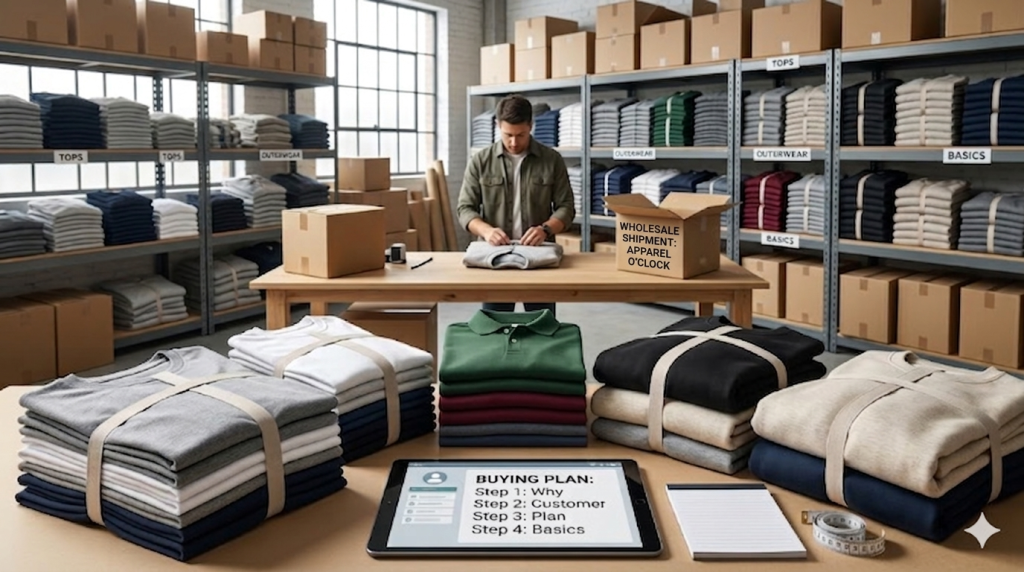
Step 1: Understand why you are buying before you order anything
The first thing you need to do is define the actual purpose of your order. Most weak wholesale decisions begin before the supplier is even chosen. They begin when people start browsing products without a clear plan.
You need to know whether you are buying for a retail clothing store, an online apparel business, a print shop, embroidery, corporate uniforms, event merchandise, school apparel, sportswear, or branded promotional use. Those are not small differences. They change everything about what you should buy.
A business that mainly sells casual basics may start with Wholesale T–Shirts because they are versatile and easy to move. A supplier serving office teams or hospitality staff may need a different base entirely and focus more on Wholesale Polos or Wholesale Dress Shirts. The point is simple. You should never buy apparel in bulk unless you know exactly what role it is supposed to play in your business.
That clarity is what protects your money.
Step 2: Know your customer better than you know the products
A lot of people spend more time comparing garments than understanding the people who are actually supposed to buy them. That is backward.
Your inventory should be shaped by your customer, not by whatever product page catches your attention. You need to know who your audience is, what they wear, how much they are willing to pay, and what they actually need from the product. If you are selling to younger buyers, they may respond better to trend-led basics and pieces like Wholesale Oversized Sweatshirts. If you are serving professional or uniform-based buyers, they may care more about polished, practical items such as Wholesale Cotton Polo Shirts or structured branded apparel.
This is where many businesses quietly lose money. They buy what they think looks appealing instead of what their customer will consistently purchase. When you understand your buyer properly, product selection becomes easier, smarter, and much less risky.
Step 3: Build a buying plan instead of buying randomly
Once you know why you are buying and who you are buying for, the next step is building a focused buying plan. This is where you stop thinking like a casual shopper and start thinking like an operator.
A good buying plan should include your core product categories, expected sales purpose, approximate quantities, and a rough idea of how each item contributes to your business. Some pieces will act as core volume drivers. Some will help you expand your offering. Some may exist to improve average order value or make your assortment feel more complete.
That does not mean your first order should be huge. It means your first order should make sense. You may decide to begin with staple garments and then later support your apparel offering with items like Wholesale Bags, Wholesale Accessories, or Wholesale Headwear if your customer base actually benefits from them. Smart buying is not about looking complete. It is about being commercially sharp.
Step 4: Start with proven basics before expanding into a variety
One of the biggest mistakes in wholesale apparel buying is trying to look like a full-scale distributor too early. That usually leads to bloated inventory and weak sell-through.
Your first priority should be products that are easier to sell, easier to restock, and easier to understand. Basics are usually where the strongest bulk buying decisions begin because they serve more use cases and create fewer surprises. Once you have that base, then you can expand intelligently.
For example, if you are building a tee offering, you may start with general-use products before testing smaller style additions like Wholesale Pocket T–shirts or Wholesale V-Neck T–shirts. Those can absolutely be useful, but they should support your range rather than define it too early.
This is where discipline matters. A tighter inventory with stronger demand is always better than a bigger one that just looks impressive on paper.
Step 5: Check fabric quality and garment construction properly
This is the step many buyers underestimate, and it causes real damage later.
Product photos can hide a lot. A garment can look clean online and still perform badly once it is worn, washed, printed, or resold. That is why fabric and construction quality need to be taken seriously from the start.
You should pay attention to weight, softness, shrinkage risk, seam quality, collar retention, stitching consistency, and overall feel. If the apparel will be customized, you also need to think about how well it handles screen printing, embroidery, or heat transfer. A product that seems cheap at first can become expensive fast if it creates returns, complaints, or decoration problems.
That is true whether you are reviewing Wholesale Short Sleeve T–shirts, wholesale Long Sleeve T–shirts, or more casual athletic-style pieces like Wholesale Jersey T–shirts. Good wholesale buying depends on what happens after the garment arrives, not just how it looked when you ordered it.
Step 6: Choose brands based on business fit, not hype or price alone
A lot of buyers get stuck in a lazy mindset. They either chase the cheapest possible option or they copy whatever brand name they see used most often. Both approaches are weak.
The right brand is the one that fits your business model, your customer expectations, and your pricing strategy. That means you need to think about softness, fit, consistency, stock depth, decoration friendliness, and how the brand is perceived in your market.
If you are comparing options for blanks or resale, you may evaluate lines like wholesale Gildan Apparel, wholesale Next Level Apparel, or wholesale Bella + Canvas apparel, depending on what matters most to your customer. If your business is more utility-driven or uniform-focused, you may look at alternatives like wholesale port and company or wholesale port authority clothing because they often serve a different commercial purpose.
The correct choice is not the cheapest brand or the trendiest brand. It is the one that helps you sell more effectively without creating unnecessary problems.
Step 7: Make sure the products can actually be restocked
One of the dumbest wholesale mistakes is buying a product that sells well and then discovering you cannot get it again when you need it.
A lot of people focus only on the first order. Serious buyers think beyond that immediately. If you want to build repeat business, your supplier needs to offer consistent availability, dependable color ranges, and strong size continuity.
This matters more than people realize. A customer who comes back to reorder wants consistency, not excuses. If you build demand around a specific item and then lose access to it, you create unnecessary friction in your own business.
That is why products like Wholesale Short Sleeve Polo Shirts or any other repeat-use item should never be judged only by today’s stock. You need to know whether the supplier can support tomorrow’s demand too.
Step 8: Get your sizing mix right or you will waste money fast
Size planning is not exciting, but it is one of the most financially important parts of buying wholesale apparel in bulk.
A lot of inventory problems come from getting the size run wrong. Buyers often over-order sizes they assume will move and under-order the sizes that actually sell first. The result is dead stock in one area and lost sales in another.
You need to build your size mix based on logic and, ideally, real data. If you already have sales history, use it. If you are new, start with a balanced range and then refine it after your first order cycle. That is a far better strategy than ordering based on instinct.
This matters across every category, whether you are buying basics or more structured garments like Wholesale Long Sleeve Polo Shirts. The right product with the wrong size distribution is still a weak buying decision.
Step 9: Buy with the season in mind, not just what looks useful
Even good inventory can become bad inventory if you buy it at the wrong time.
Seasonality affects demand, storage, cash flow, and how quickly products move. If you order winter-heavy products too late, you miss the best selling window. If you order too early without a plan, you tie up money in stock that sits.
That is why your buying calendar should reflect real customer demand. As colder months approach, categories like Wholesale Sweatshirts often become more relevant. But even within that, you still need to think carefully. Some audiences may prefer practical layering pieces like Wholesale Pullover Sweatshirts, while others may lean toward more polished cold-weather options like Wholesale Outerwear depending on how they use the products.
A strong buyer does not just think about what to order. They think about when that order will actually start earning back money.
Step 10: Sample before you commit to a serious bulk order
If you are placing a meaningful wholesale order without sampling first, you are gambling. That is the truth.
Before buying in volume, you should test what you are considering. Feel the garment, wash it, inspect the stitching, check the fit, evaluate how it behaves after use, and if needed, test how it prints or embroiders.
This matters because small differences become very expensive when multiplied across dozens or hundreds of units. It is one thing to be disappointed by one sample. It is another to be stuck with cartons of disappointing inventory.
Sampling becomes especially important when you are evaluating products with functional or style-specific performance expectations, such as Wholesale Performance T–Shirts, Wholesale Performance Polo Shirts, or structured layering pieces like Wholesale Quarter-Zip Sweatshirts. Those products have to do more than just exist. They have to perform.
Step 11: Calculate your true cost before you place the order
This is where people often fool themselves.
They see a low unit price and assume the order is profitable. That is sloppy thinking. Your real cost is not just the price per garment. It includes shipping, handling, taxes, decoration, packaging, storage, possible returns, and the financial risk of inventory that may not move quickly.
If you skip this calculation, you can end up choosing a “cheap” product that quietly destroys your margin later. A slightly more expensive product may actually perform better if it sells faster, holds up better, and creates fewer problems.
This is especially important when comparing commercial product lines or value-driven categories such as wholesale district apparel or wholesale A4 clothing, where the true profitability depends on how the product behaves in your actual business model.
You should always buy based on margin reality, not price illusion.
Step 12: Keep your first major order controlled and useful
A lot of people think a big first order makes them look serious. It does not. It just makes mistakes harder to recover from.
Your first bulk order should be large enough to test the market properly but controlled enough that you can learn from it without getting trapped by it. You are not trying to prove confidence. You are trying to gather useful information.
That means understanding which products move, which colors sit, which sizes repeat, and what your customers actually respond to. It also means being careful when you test more specific products that may not have immediate mass demand.
For example, if you are trying additions like Wholesale Pocket Polo Shirts or more layered casual pieces such as Wholesale Full-Zip Sweatshirts, those should usually be approached with measured quantities until real demand proves itself.
Restraint is not a weakness in wholesale buying. It is professionalism.
Step 13: Expand your catalog only when there is a reason to do it
A lot of wholesale buyers start expanding too soon. They add more products because they think more variety automatically creates more sales. Usually, it just creates more confusion and more dead stock.
Every new product should have a purpose. It should either serve a clear customer need, support an existing top-selling category, improve bundle potential, or raise average order value in a practical way.
That is where controlled expansion becomes useful. Once your core inventory is working, you may find room for supportive cold-weather or add-on items like Wholesale Beanies, Wholesale Caps, or style-specific accessories like Wholesale Snapback Hats. But those items should be added because they make business sense, not because you feel pressure to offer everything.
A smaller catalog with strong logic behind it will usually outperform a larger one built on guesswork.
Step 14: Look at how the brand sits in the market, not just what the product is
Not all wholesale garments are created for the same type of customer, even when the product category looks nearly identical.
That is why you need to think about brand positioning as much as product function. One brand may feel more promotional and value-driven, while another may feel more premium and retail-ready. Both can work, but not for the same customer or pricing strategy.
This is where comparison matters. You might find that Wholesale Fruit Of The Loom Apparel makes sense for certain volume-driven use cases, while Wholesale Anvil Clothing may appeal differently depending on your quality and market expectations. If your business serves more polished or professional buyers, options like Wholesale Red House Clothing or Wholesale Wink Apparel may be more aligned with what your customers expect.
A good buyer understands that the brand story behind the product can affect how easily it sells.
Step 15 Think beyond tops if your customer needs a fuller solution
A lot of apparel buyers stay too narrow for too long. They focus only on shirts and ignore whether their customer actually needs a more complete product offering.
If your market supports it, wholesale apparel buying may eventually need to include complementary categories that help customers buy more from one place. That could mean adding bottoms, outer layers, or practical pieces that support uniforms, teamwear, or business dress requirements.
In some cases, that may involve structured inventory like Wholesale Pants or building out a more complete seasonal offering. The key is not expanding just to look bigger. The key is expanding when it solves a real customer need and makes your assortment more commercially useful.
If your buyers want complete solutions, your catalog should be built to support that.
Step 16: Track what sells and let that data improve every future order
This is where long-term buying skill actually comes from.
Your first few orders should not just move products. They should teach you what your business needs to do next. You need to track which products sell first, which sizes repeat, which colors underperform, what gets reordered, and what customers ignore.
That information is more valuable than opinions.
You may find that your customer base prefers clean basics over trend-driven silhouettes. You may discover that functional add-ons outperform what you expected. In some businesses, even categories like Wholesale Trucker Hats or more athletic accessories such as Wholesale Performance Hats, can end up performing better than slower-moving apparel items if they fit the market well.
The businesses that buy best are usually the ones that pay attention best. Good buying is not about guessing better. It is about learning faster.
Step 17: Avoid the common mistakes that quietly destroy margins
Most bad wholesale orders come from the same repeated errors.
People buy too many styles too early. They focus too much on low pricing. They ignore sampling. They buy without understanding seasonality. They assume customer demand instead of validating it. They fail to think about restocks. And they often buy based on appearance instead of actual commercial usefulness.
Another major mistake is keyword-style buying, where people just chase categories because they sound popular rather than because they fit the business. That kind of buying creates clutter, not growth.
If you want to get wholesale apparel buying right, you need to be more selective than emotional. That is what protects your money and improves your inventory quality over time.
Final thoughts
Learning how to buy wholesale apparel in bulk is not really about finding cheap stock. It is about building a system that helps you buy with clarity, sell with confidence, and restock with purpose.
You need to understand why you are buying, who you are buying for, which products deserve space in your catalog, how to evaluate suppliers, how to control risk, and how to let real sales data guide future decisions.
That is what separates businesses that constantly struggle with inventory from businesses that grow with more control.
The strongest wholesale buyers are not always the ones who order the most. They are usually the ones who think more clearly before they buy.
That is the step-by-step process that actually works.
FAQs
How much inventory should I buy for my first wholesale apparel order
Your first order should be large enough to test demand but small enough to avoid getting trapped in slow-moving stock. Start with proven basics, balanced size runs, and controlled quantities rather than trying to stock too many styles at once.
What is the biggest mistake people make when buying wholesale apparel in bulk?
The biggest mistake is buying without a clear purpose. Many buyers place orders before understanding their customers, their product needs, or whether the supplier can support long-term restocking. That usually leads to poor inventory decisions.
Should I always choose the cheapest wholesale apparel supplier
No. A low price means nothing if the product quality is inconsistent, the fit is poor, or the stock is unreliable. You should always compare suppliers based on quality, restock depth, consistency, and long-term business value.
Is sampling really necessary before placing a bulk order
Yes. Skipping samples is one of the fastest ways to make expensive mistakes. Sampling helps you test fit, feel, wash performance, printability, and construction before you commit real money to inventory.
How do I know which wholesale apparel categories to start with
Start with categories that match your customer demand and business model. The best first products are usually easy to sell, easy to restock, and flexible enough to work across multiple use cases. Your first order should focus on what is most commercially useful, not on trying to offer everything.