

You walk into a room and something about a person stops you mid-step. It is not their shoes or their jacket, it is their hat. A perfectly chosen hat does what no other accessory can: it frames a person’s entire presence. Yet most people settle for whatever sits on the rack nearest to the checkout counter.
That is a missed opportunity. Because whether you are looking for sun protection at the beach, a polished finishing touch for a wedding, warmth on a winter hike, or a bold fashion statement on the street, there is a specific hat engineered exactly for that moment. The challenge is knowing which one.
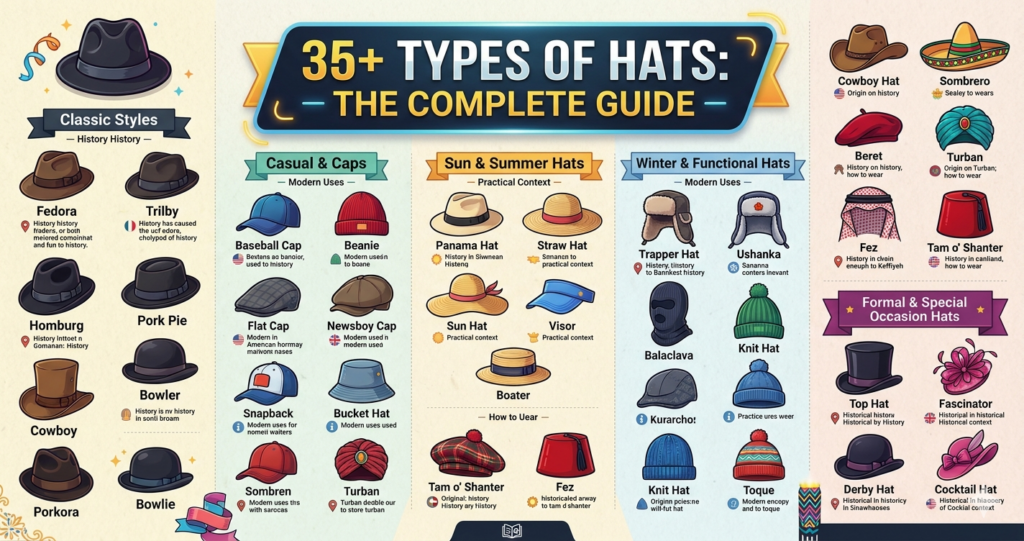
This guide covers every major hat style you need to know, over 35 types of hats, along with their history, defining features, best uses, and how to style them. By the time you finish reading, choosing the right hat will feel effortless.
What Is a Hat? Definition and Purpose
A hat is a structured head covering worn for functional, cultural, or aesthetic reasons. It typically features a shaped crown that sits on the head and, in many styles, a brim that projects outward to varying degrees.
Hats serve more purposes than most people realize. They shield against sun, rain, cold, and occupational hazards. They signal cultural identity, professional rank, and social affiliation. And in the context of fashion, they elevate an outfit from assembled to intentional.
The core purpose of any hat falls into one of four categories:
- Protection — from sun, wind, rain, snow, or physical impact
- Identification — uniforms, ceremonies, military insignia, cultural dress
- Fashion — completing an outfit, expressing personality
- Function — sport-specific performance, occupational safety
A Brief History of Hats: From Ancient Egypt to Modern Streetwear
Head coverings have existed for as long as recorded history. The story of hats mirrors the story of civilization itself, each era producing shapes that tell us exactly who wore them and why.
Ancient Origins (3000 BCE – 500 CE)
The earliest evidence of structured headwear appears in ancient Egyptian artwork, where linen and woven fabric headdresses marked royal and priestly status. Ancient Greek and Roman cultures wore the petasos, a wide-brimmed hat made of felt or straw, as practical sun protection during travel and outdoor work.
Medieval and Renaissance Periods (500 – 1600)
During the Middle Ages, elaborate headdresses became markers of nobility and wealth. The taller and more complex the headpiece, the greater the social standing of the wearer. The Renaissance brought wider brims and more ornate decorations, with feathers and ribbons signaling courtly refinement.
The 17th and 18th Centuries
Beaver fur felt hats dominated European fashion in the 1600s, with the tricorn and bicorn becoming the defining silhouettes of military and aristocratic dress. By the late 1700s, silk top hats began replacing the beaver fur styles, establishing a new language of formal prestige.
The 19th and Early 20th Centuries
This era produced the widest variety of hat styles in history. The top hat, bowler, derby, fedora, and homburg each served a precise social function. Wearing the wrong hat to the wrong occasion was a genuine social misstep. Hat-making was a major industry, and milliners were some of the most skilled craftspeople of the era.
Mid-20th Century Decline
Post-World War II, hat-wearing declined sharply in Western culture. Lower car roofs made hats impractical. The rise of casual dress culture reduced the obligation to wear them. By the 1960s, hats had shifted from a daily necessity to an occasional accessory.
Contemporary Revival
Today, hats occupy a unique position, free from strict social codes, they have become pure expressions of identity. The baseball cap became one of the most recognizable garments on earth. The beanie crossed from workwear into youth culture. And classic styles like the fedora, bucket hat, and beret cycle in and out of mainstream fashion with each generation.
Parts of a Hat: Understanding the Anatomy
Before exploring the different kinds of hats, it helps to understand the components that define each style. Every hat is a combination of these core elements, and understanding them makes it easier to compare styles and identify what you are looking at.
The Crown: The upper portion of the hat that covers the head. Crown height, shape, and structure vary dramatically between styles, a tall top hat crown versus the low, rounded crown of a bucket hat defines the entire character of each design.
The Brim: The horizontal ledge that extends outward from the crown. Brim width ranges from almost nothing on a trilby to 6+ inches on a floppy sun hat. Brims can be flat, curved, upturned, downturned, stiff, or flexible.
The Band: A decorative strip of fabric, leather, or ribbon that runs around the base of the crown where it meets the brim. Bands range from simple grosgrain ribbons to elaborate embroidered or beaded trims.
The Lining: The interior fabric layer that protects the inside of the crown, wicks moisture from the head, and helps the hat hold its shape. A quality lining extends the life of a hat significantly.
Hats vs. Caps: What Is the Difference?
The words hat and cap are often used interchangeably, but they describe genuinely different types of headwear. Understanding the distinction helps when shopping, styling, and describing what you want.
The clearest way to tell them apart: a hat has a full brim running all the way around the crown, while a cap has a peak or visor only at the front and no brim. Caps are also typically softer and less structured than hats.
| Feature | Hats | Caps |
| Brim | Full brim all around | Peak/visor only at front |
| Crown | Structured, sculpted | Soft, unstructured |
| Formality | Casual to formal | Mostly casual |
| Gender | Men & women equally | More common in men |
| Function | Style + protection | Sun-blocking, sporty |
| Examples | Fedora, Panama, Cloche | Baseball, Snapback, Trucker |
There is also a cultural difference. Caps tend to communicate casual, athletic, or youthful energy, while hats span a broader range from relaxed to highly formal depending on the style. Both are valid and versatile, the right choice depends entirely on context.
35+ Types of Hats: Quick Reference by Category
Here is a complete overview of the major hat styles covered in this guide, organized by their most common use case.
Casual & Everyday
- Baseball Cap — the universal everyday cap
- Beanie — cold-weather staple
- Bucket Hat — relaxed outdoor wear
- Dad Hat — unstructured baseball-style cap
- Snapback — adjustable street-style cap
- Flat Bill Hat — urban streetwear cap
- 5 Panel Hat — lightweight casual cap
- 6 Panel Hat — structured classic cap
- Trucker Hat — mesh-backed casual cap
Formal & Semi-Formal
- Fedora — versatile semi-formal felt hat
- Trilby — narrow-brimmed dress hat
- Top Hat — the most formal hat in history
- Bowler / Derby Hat — British formal classic
- Pork Pie Hat — round-crown semi-formal style
- Fascinator — British formal occasion headpiece
Outdoor & Functional
- Sun Hat / Floppy Hat — maximum sun coverage
- Panama Hat — breathable summer straw hat
- Cowboy Hat — wide-brim western protection
- Boonie Hat — military-origin wide-brim outdoor hat
- Visor — crownless sun-blocking cap
- Performance Hat — moisture-wicking athletic cap
- Camo Hat — hunting and outdoor camouflage cap
- Fitted Hat — tailored, precise-fit cap
- Hard Hat — industrial safety helmet
Cold Weather
- Trapper / Aviator Hat — ear-flap winter hat
- Flat Cap — versatile cool-to-cold weather style
Cultural & Traditional
- Sombrero — wide-brim Mexican heritage hat
- Beret — French-influenced soft round hat
- Cloche Hat — 1920s bell-shaped women’s hat
- Sailor Hat — naval and nautical-themed cap
Occupational & Ceremonial
- Chef Hat / Toque — professional kitchen headwear
- Graduation Cap / Mortarboard — academic ceremony
- Army Hat — military uniform headwear
Festive & Costume
- Santa Hat — Christmas celebration headwear
- Party Hat — birthday and festive events
- Witch Hat — Halloween and theatrical costume
Detailed Breakdown of Each Hat Type
Each style below includes its defining features, ideal occasions, and what makes it worth knowing.
1. Beanie
Best For: Cold weather, outdoor activities, casual everyday wear
The beanie is a close-fitting, brimless knit hat that pulls snugly over the head and ears. It originated as a utilitarian working-class garment and evolved into one of the most culturally versatile hat styles ever made. From ski slopes to city streets to concert venues, beanies signal approachability and unpretentious style. Modern versions range from tight ribbed cuts to loose, slouchy silhouettes. They are available in every imaginable color and material, from basic acrylic blends to premium Merino wool.
2. Cowboy Hat
Best For: Western events, outdoor work, sun protection in open environments
The cowboy hat is defined by its broad brim, typically four to five inches wide, and its tall, pinched crown. Originally engineered for the practical demands of ranching and outdoor labor in North America, the hat shields the face, neck, and shoulders from intense sun and deflects rain. The Stetson brand became synonymous with the style in the 19th century. Today it carries strong cultural associations with country music, Western fashion, and American frontier heritage. Materials include felt for colder weather and straw for summer wear.
3. Bucket Hat
Best For: Fishing, hiking, beach days, casual warm-weather outings
The bucket hat has a soft, downward-sloping brim all around the crown, giving it a relaxed, informal profile. Originally designed as a practical outdoor hat for fishermen and farmers in the early 1900s, it crossed into mainstream fashion in the 1960s and has since cycled through multiple fashion eras. Hip-hop culture adopted it in the 1990s, and it has remained a summer streetwear staple ever since. Modern bucket hats come in denim, cotton, nylon, and even luxury fabrics from high-end fashion houses.
4. Dad Hat
Best For: Everyday casual wear, brand promotions, relaxed weekend style
The dad hat is a low-profile baseball-style cap with an unstructured front panel, a slightly curved brim, and a strap adjuster at the back, typically a brass buckle or sliding clasp. The name captures the effortlessly unstudied quality of the style: worn in, unpretentious, comfortable. Though it shares the same basic structure as other baseball caps, the dad hat’s unstructured profile and relaxed fit distinguish it from snapbacks and fitted caps. It became a significant streetwear item in the mid-2010s after years of being overlooked.
5. Fedora
Best For: Semi-formal occasions, vintage-inspired outfits, fashion-forward styling
The fedora has a medium to wide brim and a soft felt crown with a center crease running lengthwise, plus two indentations near the front. This distinctive pinched, creased profile is what immediately identifies a fedora at a glance. The style emerged in the late 19th century and reached peak mainstream popularity in the 1940s, when it became inseparable from the image of the sharp-dressed American man. Despite going out of mainstream daily wear, it has never truly disappeared, cycling back into fashion every decade or so. Wool felt is the traditional material; straw fedoras serve as the summer variant.
6. Trilby Hat
Best For: Smart-casual settings, music events, fashion-forward urban wear
The trilby is often mistaken for a fedora, but it is distinctly different: it has a much narrower brim, sometimes called a stingy brim, that angles sharply downward at the front and curves up at the back. The crown is similar to a fedora but sits slightly lower. The trilby has strong associations with British musical culture, jazz scenes, and 1960s mod fashion. It reads as sharper and more angular than a fedora, lending outfits a slightly more editorial quality. It works best with slim-cut clothing where the hat’s proportions can dominate.
7. Baseball Cap
Best For: Sports, casual everyday wear, outdoor activities, promotional apparel
The baseball cap is the single most widely worn hat style on earth. Its structure includes a rounded, segmented crown, typically six panels, and a stiff curved brim at the front. Originally developed as functional sportswear for baseball players in the 19th century, it became a cultural artifact unto itself by the 20th century. Every major sports team, brand, and cultural moment has been rendered in baseball cap form. The cap communicates a casual, accessible energy that makes it universally wearable across demographics, climates, and occasions — from dugouts to designer runways.
8. Snapback
Best For: Streetwear, casual wear, brand culture, urban fashion
The snapback is a structured baseball-style cap defined by its flat brim and the adjustable plastic snap closure at the back, hence the name. It is usually a six-panel construction with a stiffer crown than a dad hat. Snapbacks became a defining symbol of early 1990s hip-hop culture and have remained a street fashion staple. The flat brim is typically left uncurved, which gives the hat a distinctive geometric quality compared to the softer curve of traditional baseball caps. They are heavily used in brand collaborations and limited-edition fashion drops.
9. Flat Bill Hat
Best For: Urban streetwear, skateboarding culture, casual city wear
The flat bill hat shares the basic structure of a baseball cap but keeps the brim completely flat and rigid rather than curved. The style originated in West Coast hip-hop and skateboarding subcultures and became particularly prominent in the 2000s. Wearing a flat bill hat with a slightly off-center position became a recognizable style signal in streetwear communities. Today, the style has been absorbed into mainstream fashion and is available from both affordable and luxury brands.
10. Bucket Hat (Boonie Variant)
Best For: Military use, hiking, fishing, tropical outdoor environments
The boonie hat is the military-issue cousin of the civilian bucket hat. It features a wider, more rigid brim and typically includes a chin strap for securing the hat in wind, loops around the brim for attaching foliage as camouflage, and ventilation eyelets for airflow. Used extensively by US forces in Vietnam and Southeast Asia, the boonie hat became the functional outdoor hat of choice for serious hikers, hunters, and anyone working in exposed terrain. Its military heritage gives it a more rugged aesthetic than the civilian bucket hat.
11. Sun Hat / Floppy Hat
Best For: Beach, garden parties, outdoor events, warm-weather sun protection
The sun hat, often called a floppy hat due to its soft, flexible brim, prioritizes maximum coverage over structured style. Brims typically range from four to seven inches wide, providing substantial shade for the face, neck, and shoulders. The crown is usually unstructured and relaxed. Sun hats are a staple of resort and beachwear fashion, frequently made in natural straw, cotton, or paper braid, and often seen in natural tan, white, or pastel tones. They have a romantic, unhurried quality that pairs easily with flowing dresses and linen fabrics.
12. Panama Hat
Best For: Summer events, beach vacations, semi-formal warm-weather occasions
Despite the name, the Panama hat is traditionally woven in Ecuador from toquilla palm fiber. The confusion arose in the 19th century when the hats were shipped through Panama on their way to markets in North America and Europe. Genuine Panama hats are lightweight, breathable, and extraordinarily fine-woven, the most prized examples, called Montecristi superfinos, can take months to weave a single hat. The shape follows a fedora or wide-brimmed profile. They are considered one of the most elegant summer accessories in existence.
13. Flat Cap
Best For: Smart-casual wear, cooler weather, vintage and heritage styling
The flat cap has a low, rounded crown and a small stiff brim only at the front. Its defining characteristic is the way the crown is sewn to the brim at the front, giving it a distinctive silhouette. Originating as working-class British headwear in the late 19th century, the flat cap was strongly associated with industrial laborers and northern English culture. Over time it crossed class lines and became a respected fashion item. Today it reads as heritage-informed and quietly sharp, popular in tweed for autumn styling, cotton for spring, and wool for winter.
14. Beret
Best For: Parisian-inspired outfits, artistic settings, military dress uniforms
The beret is a soft, round, flat-crowned hat with no brim. It sits on the head at an angle, typically tilted to one side. Berets have a long history in European fashion, with roots in the Basque region of France and Spain. They became globally associated with French culture and the archetype of the intellectual or artist. They also serve significant military functions, used as standard issue in many armies worldwide, where the color of the beret signals regiment and rank. In fashion, the beret has enjoyed multiple major revivals and is a perennially elegant choice for autumn and winter styling.
15. Cloche Hat
Best For: Vintage or retro outfits, 1920s-themed events, feminine occasion wear
The cloche hat is a fitted, bell-shaped hat with a deep crown that sits low on the forehead, often almost to the eyebrows. It was the defining hat silhouette of the 1920s flapper era, inseparable from the bobbed hair and Art Deco fashion of that decade. The name comes from the French word for bell, which accurately describes its smooth, domed profile. Cloche hats became symbolic of women’s social liberation in the 1920s and remain the most immediately recognizable vintage hat style from that era.
16. Bowler / Derby Hat
Best For: Vintage-inspired outfits, formal occasions, theatrical costume, heritage events
The bowler hat features a hard felt crown that is rounded and dome-shaped, with a narrow brim that curves slightly upward at the edges. It was originally designed in 1849 by hatters Thomas and William Bowler for a British gamekeeper who needed protective headwear that would not be knocked off by low-hanging branches while on horseback. The hat became a symbol of British respectability and middle-class formality throughout the late 19th and early 20th centuries. Charlie Chaplin’s iconic use of the hat as a costume prop cemented its place in popular culture globally.
17. Top Hat
Best For: Formal events, theatrical performances, historical costume
The top hat is the most architecturally dramatic hat ever to achieve widespread mainstream use. Its defining feature is an exceptionally tall, flat-topped cylindrical crown, paired with a wide, flat brim. In the 19th century, the top hat was the standard formal hat for men of standing, worn at everything from horse races and weddings to Parliament and the opera. Today, genuine top hat occasions are rare, but the style remains powerfully symbolic of formality, theater, and a certain brand of theatrical elegance.
18. Fascinator
Best For: Weddings, horse racing events, formal British occasions
A fascinator is a small decorative headpiece designed to be worn at an angle, typically attached to the hair with a clip or comb. Unlike most hats, it does not cover the head, it is purely ornamental. Fascinators range from simple feathered clips to elaborate sculptural constructions featuring flowers, netting, ribbons, and architectural forms. They are a cornerstone of British occasion dress, appearing at events like Royal Ascot, Henley Royal Regatta, and society weddings. The rules of formal British dress often require a head covering, and the fascinator provides an elegant, fashion-forward solution.
19. Pork Pie Hat
Best For: Semi-formal wear, jazz and blues culture, vintage-inspired outfits
The pork pie hat features a flat top, a low crown, and a narrow brim that is turned up all around the circumference. The flat crown, viewed from above, resembles the classic British meat dish that gives the hat its name. The style has deep roots in jazz and blues culture, worn by musicians like Lester Young and Buster Keaton, and carries a relaxed but distinctive edge. It is made in felt for cooler weather and straw for summer, and bridges casual and semi-formal dress codes with more ease than most hat styles.
20. Sombrero
Best For: Mexican cultural celebrations, traditional festivals, costume wear
The sombrero is defined by its extraordinarily wide brim, one of the widest of any hat style — and its tall, pointed crown. The word sombrero simply means hat in Spanish, but outside of Spanish-speaking countries it specifically refers to this wide-brimmed Mexican style. The design was born out of practical necessity: the wide brim provides comprehensive protection from the intense sun for agricultural workers in Mexico and the American Southwest. Traditional sombreros are made from straw or felt and decorated with embroidery, metallic thread, or fringe.
21. Trapper / Aviator Hat
Best For: Winter sports, cold-weather outdoor activities, arctic conditions
The trapper hat is built for a serious cold. It features a structured crown with fur or synthetic insulation on the outside and ear flaps that fold down to cover the ears and tie or snap under the chin, or fold up and fasten on top of the crown when not needed. The style was used by fur trappers in northern North America and Russia for centuries before being adopted by military aviators in World War I and II, hence the alternate name. Today it is the go-to hat for genuinely frigid conditions, combining maximum warmth with practical design.
22. Hard Hat
Best For: Construction sites, industrial workplaces, mining, electrical work
The hard hat is a safety device that happens to be worn on the head. Its rigid shell, typically made of high-density polyethylene or polycarbonate, is designed to deflect falling objects, resist penetration, and absorb impact energy. The suspension system inside the shell keeps the hat slightly away from the skull, creating a buffer zone that further reduces force transmission on impact. Hard hats are color-coded in many industries to indicate roles and seniority on a worksite. Custom colors and logos are used by companies to build team identity and ensure compliance is visually trackable.
23. Visor
Best For: Golf, tennis, running, outdoor sports in warm weather
The visor is the most minimal hat style: a brim with no crown at all, secured around the head with an adjustable strap. It blocks direct sunlight from the face while allowing maximum airflow and heat dissipation from the top of the head, making it ideal for high-intensity outdoor sports where overheating is a concern. Visors are closely associated with golf and tennis, where they have been worn by top athletes for decades. They are also popular for running and hiking. The absence of a crown makes them poor choices for sun protection on the top of the head, so they work best with hair that provides natural coverage.
24. Chef Hat / Toque
Best For: Professional kitchens, culinary competitions, cooking events
The classic chef’s toque is a tall, white, cylindrical hat with a pleated fabric crown. Its height has traditionally been associated with rank in the kitchen, head chefs wearing taller toques than junior cooks. The pleats were historically said to represent the number of ways a chef could prepare eggs. In practice, the hat keeps hair contained and out of food, absorbs sweat, and signals professional status. While the towering traditional toque has given way in many modern kitchens to lower-profile alternatives, it remains the defining symbol of the culinary profession.
25. Graduation Cap / Mortarboard
Best For: Graduation ceremonies, academic events, doctoral installations
The mortarboard is one of the most universally recognized ceremonial garments in the world. Its flat, square top and tassel identify it instantly as a symbol of academic achievement. The tassel is positioned on the right side before the degree is conferred and moved to the left as part of the ceremony, a physical marking of the transition from candidate to graduate. The mortarboard has been standard academic dress in English-speaking countries since the 19th century and is worn across undergraduate, graduate, and doctoral ceremonies with variations in hood color indicating the field of study and degree level.
26. Santa Hat
Best For: Christmas celebrations, holiday parties, festive events
The Santa hat is a simple conical hat in red felt with a white cuff at the base and a white pom-pom at the tip. Its design is derived from the costume of Santa Claus as popularized in 20th-century American commercial Christmas imagery. The hat is cheerful, immediately recognizable, and deliberately cartoonish, worn at holiday events as a signal of festive participation rather than fashion. Its simplicity makes it universally accessible, and it appears reliably every December across department stores, offices, schools, and public gatherings worldwide.
27. Witch Hat
Best For: Halloween, costume parties, theatrical and stage productions
The witch hat is a tall, conical hat with a wide brim and a dramatically pointed tip. Its association with witches in Western folk mythology dates back to the Middle Ages and has been reinforced by centuries of illustrations, stories, and theatrical productions. The hat is almost always rendered in black and frequently embellished with a buckle, band, or cobweb detailing. It is purely a costume hat with no practical function, its entire value is symbolic and theatrical. Every Halloween season, it becomes one of the most produced hat styles in the world.
28. Sailor Hat
Best For: Nautical events, military ceremonies, sailor-themed costume
The classic sailor hat is a flat, circular, brimless cap with a stiff top and a band around the base. Naval sailors worldwide have worn variations of this style since the 19th century. The black silk ribbon or tally around the band typically bears the name of a ship or naval unit. In civilian fashion, the sailor hat carries strong nautical associations and has appeared in children’s dress, theme parties, and fashion collections inspired by maritime culture. Its clean, geometric form gives it an appealingly crisp quality outside of strictly naval contexts.
29. Camo Hat
Best For: Hunting, outdoor adventure, streetwear with military influence
Camouflage hats apply disruptive pattern material to standard cap constructions, most commonly baseball cap or bucket hat shapes, to break up the wearer’s visual outline in natural environments. Originally purely functional for hunters and military personnel, camo patterns crossed into mainstream fashion in the 1990s and have remained a streetwear staple. The irony of wearing camouflage in urban environments where it provides no concealment is part of its appeal, it signals outdoor credibility and a certain anti-establishment edge.
30. Performance Hat
Best For: Running, hiking, cycling, competitive sports
Performance hats are engineered specifically for athletic use. They use moisture-wicking synthetic fabrics to draw sweat away from the skin, UV-protective materials to reduce sun exposure, and lightweight constructions that minimize the hat’s impact on athletic movement. Many performance hats incorporate laser-cut ventilation panels, adjustable closures, and reflective detailing for visibility in low-light conditions. They represent the convergence of textile technology and hat design, built to function under conditions where conventional hats would become uncomfortable or counterproductive.
31. Fitted Hat
Best For: Everyday wear, sports fandom, clean tailored looks
A fitted hat is a baseball-style cap sized to exact head measurements with no adjustment mechanism. Without a snapback, buckle, or elastic strap, the fitted hat sits with a cleaner, more precise profile against the head. This tailored quality made fitted caps the hat of choice for professional athletes across multiple sports, particularly Major League Baseball, where fitted caps remain standard uniform. In streetwear culture, wearing a fitted hat, especially one in an official sports colorway, signals authenticity and attention to detail.
32. 5 Panel Hat
Best For: Casual wear, cycling culture, minimalist streetwear
The 5 panel hat is constructed from five fabric panels rather than the standard six, which eliminates the center seam at the top of the crown and gives the hat a flatter, lower profile. This construction originated in cycling and outdoor sports before being adopted by skateboarding and streetwear communities. The simpler shape makes it ideal for clean embroidery or print designs, which is why it became popular for artist merchandise and independent brand drops. It sits closer to the head than a structured six-panel cap, giving it a more fitted appearance despite typically being unstructured.
33. 6 Panel Hat
Best For: Everyday wear, sports, brand merchandise, versatile casual use
The six-panel hat is the foundational architecture of most baseball caps. Its six triangular panels meet at a central button on top of the crown, creating the familiar rounded dome profile. The structured front panels allow embroidery and printed logos to sit cleanly, making it the default choice for branded merchandise, team caps, and promotional headwear. Within the six-panel category, variations in structure, material, brim curve, and closure style create a broad family of cap sub-types, from stiff structured snapbacks to soft unstructured dad hats.
34. Army Hat
Best For: Military service, tactical wear, military-themed apparel
Army hats encompass a broad category of military headwear across different branches and nations. The most common civilian iteration is the patrol cap, a simple, low-profile cap with a short brim made in olive drab, coyote tan, or digital camouflage patterns. Army hats also include the beret worn in various colors by different military units, ceremonial peaked caps with branch insignia, and the boonie hat used in field operations. In civilian fashion, surplus and replica military caps carry associations of utility, durability, and a certain understated toughness.
35. Party Hat
Best For: Birthday parties, New Year’s celebrations, festive gatherings
The party hat is a simple conical hat made from thin, brightly decorated cardboard and secured with an elastic chin strap. It has no practical function whatsoever, its only purpose is to signal celebration and create visual joy. The paper cone shape lends itself easily to printing, decoration, and mass production, making party hats one of the most affordable festive accessories available. Despite their simplicity, they carry genuine cultural weight as a universal symbol of birthday celebrations and communal festivity across cultures worldwide.
Styling Guide: How to Wear Different Types of Hats for Men
The right hat can anchor an entire outfit — or destroy one. These combinations work because they match the energy of the hat to the energy of the clothes.
Baseball Cap
Pair with joggers and a crewneck for an easy casual look, or go streetwear with a graphic tee, straight-leg jeans, and chunky trainers. Keep everything else simple, let the cap do the talking.
Fedora
A fedora demands the right outfit. In cooler months, wear it with a tailored overcoat, slim trousers, and Chelsea boots. In summer, go for linen trousers, an open-collar shirt, and loafers. Never pair it with overly casual clothing, a fedora with cargo shorts sends the wrong message.
Beanie
Beanies pair with almost anything. Classic look: slim beanie, wax jacket, dark jeans, and boots. Street-style look: slouchy beanie, bomber jacket, and high-tops. Stick to neutral colors for maximum versatility; go bold only when the rest of the outfit is toned down.
Flat Cap
For a heritage look, go tweed flat cap with a field jacket and leather boots. For something more modern, try a cotton flat cap with a bomber jacket and slim chinos. It adds quiet sophistication without tipping into formalism.
Cowboy Hat
Wear it with commitment. Dark-wash jeans, a Western-yoke shirt, and boots are the natural combination. Mixing a cowboy hat into a non-Western outfit can work, but every other detail needs to be considered carefully to avoid looking like a costume.
Styling Guide: How to Wear Different Types of Hats for Women
Sun Hat / Floppy Hat
A wide-brimmed sun hat is at its best as part of a relaxed, flowing summer outfit. Pair it with a linen maxi dress, strappy sandals, and simple gold jewelry for a beach-ready look that feels effortless rather than overdressed. For a garden party, a structured straw sun hat works with a floral midi dress and wedge heels. The key is to let the hat’s scale be the statement — keep other accessories minimal.
Beret
The beret’s Parisian associations make it a natural partner for structured, somewhat romantic outfits. A classic combination is a beret in camel or burgundy with a striped Breton shirt, tailored trousers, and ballet flats. For a more modern interpretation, a black beret works with a black turtleneck, wide-leg trousers, and ankle boots. The beret looks best when worn slightly to one side, a completely centered beret loses the casual elegance that defines the style.
Bucket Hat
The bucket hat is the summer hat with the broadest styling range. It pairs as easily with a swimsuit and coverup at the beach as it does with oversized streetwear pieces in the city. For a put-together casual look, combine a bucket hat in a neutral or pastel tone with a fitted crop top, high-waisted straight-leg jeans, and slides. The bucket hat works particularly well as a color or print accent when the rest of the outfit is kept neutral.
Wide-Brimmed Hat
A structured wide-brimmed hat communicates deliberate elegance. For outdoor events, pair it with a fitted midi dress, block-heel sandals, and a simple clutch. The hat provides shade and frames the face dramatically, which means hair styling matters less, but facial expressions are more visible. Choose a color that either matches the outfit precisely or contrasts it significantly; the middle ground of closely similar but not matched shades tends to look unresolved.
Fascinator
Fascinators follow specific occasion rules. They are appropriate at weddings, formal horse racing events, and cocktail parties, not at casual gatherings. The placement and scale of a fascinator should be considered relative to the hairstyle: larger, sculptural fascinators require hair that is styled up or slicked back to avoid visual competition. Coordinate the fascinator’s color with one element of the outfit, the dress, shoes, or bag, rather than trying to match everything simultaneously.
How to Choose the Right Hat: 10 Practical Tips
Knowing the names of hat styles is only the first step. Choosing the right one for your situation requires thinking through a few key factors.
1. Match the Hat to the Occasion:
Formal events call for structured, brimmed styles like fedoras, fascinators, or Panama hats. Casual outings open the full range. Active outdoor use demands functional materials and secure fit. Fancy-dress events are an exception to every rule.
2. Consider Your Face Shape:
Oval faces are the most versatile and suit almost any hat style. Round faces benefit from hats with height, tall crowns add vertical length. Square faces are softened by rounded crowns and asymmetric brim angles. Long faces work well with wide, horizontal brims that add visual width.
3. Choose Fabric for the Season:
Felt, wool, and fleece for autumn and winter. Straw, cotton, linen, and synthetic performance fabrics for spring and summer. Year-round styles like the baseball cap and beanie work across seasons when the material weight is appropriate.
4. Get the Fit Right:
A hat that is too tight causes discomfort and headaches. One that is too loose blows off in the wind and sits awkwardly. Measure your head circumference before buying and place a flexible tape around the head about one inch above the ears. Most brands publish sizing charts with measurements.
5. Consider Proportions:
Large brims add drama but require the confidence to carry them. Low-profile caps create a casual, understated look. Match the hat’s visual scale to the occasion and to your own physical proportions.
6. Coordinate with Your Outfit Colors:
Neutral hats in black, navy, khaki, or natural straw work with virtually everything. If you choose a bold color, ensure it appears at least once more in the outfit to look intentional rather than accidental.
7. Think About Practicality:
A beautiful wide-brimmed hat is impractical in wind without a chin strap. A structured felt hat should not be worn in heavy rain. Match the hat’s construction to the actual conditions you will encounter.
8. Consider Your Hairstyle:
Beanies and baseball caps compress hair significantly, factor this in for occasions where hair appearance matters. Wide-brimmed hats with deep crowns can flatten hairstyles but simultaneously make the style irrelevant. Fascinators require specific updos or styled hair to work properly.
9. Try Before Committing:
Hat sizing and proportions are highly individual. A style that looks extraordinary on one person may not work on another with a different face shape, head size, or personal style. Whenever possible, try hats in person before purchasing.
10. Start Simple and Build Confidence:
If hats feel unfamiliar, begin with a baseball cap or beanie, styles with almost no styling risk. As you become comfortable wearing hats, graduate toward more expressive styles. The biggest barrier to wearing hats well is simply not wearing them enough.
Conclusion
Hats are among the oldest, most purposeful, and most expressive garments ever developed. From the ancient Egyptian headdresses of the ruling class to today’s streetwear snapbacks and luxury Panama hats, every style in this guide carries a specific history, a specific function, and a specific set of associations.
Understanding the differences between hat styles, what makes a trilby distinct from a fedora, how a bucket hat differs from a boonie, why a fascinator is not simply a small hat, gives you the vocabulary to make intentional choices. And intentional choices, across all areas of dress, are what separate style from accident.
Whether your goal is practical sun protection, professional appropriateness, seasonal warmth, or pure sartorial expression, there is a specific hat built exactly for that purpose. Now you know which one to reach for.
FAQ’S
What are the most popular types of hats for everyday wear?
The baseball cap, beanie, and bucket hat. All three work across climates, suit casual settings, and need minimal styling. The dad hat and snapback are solid alternatives.
How do I choose a hat that suits my face shape?
Oval faces suit almost anything. Round faces benefit from taller crowns; square faces from softer, rounded shapes; long faces from wide brims that add horizontal width. Try styles in person, theory only goes so far.
What is the difference between a fedora and a trilby?
Brim width. A fedora has a medium-to-wide brim (3–4 inches); a trilby has a narrow brim under two inches, angled sharply down at the front. Both have pinched crowns, which is why they get confused.
What hat styles are best for women at formal events?
Fascinators and wide-brimmed structured hats for British-style formal events like weddings and racing. A Panama or structured straw hat for outdoor daytime occasions; a beret or felt hat for indoor formal settings.
What is the difference between a hat and a cap?
A hat has a full brim running all the way around the crown. A cap has only a front peak with no brim. Hats span casual to formal; caps are almost always casual.
How do I care for different types of hats?
Felt hats: brush counterclockwise and store on a hat stand. Straw hats: keep dry, store flat. Baseball caps and beanies: hand-wash or machine-wash in a mesh bag on gentle, never tumble dry. Wool beanies: hand-wash cold, lay flat to dry.
What hat styles are currently trending?
Bucket hats, wide-brimmed straw hats, and camo caps have held strong in recent seasons. The beret and cloche hat return regularly with vintage fashion cycles. The baseball cap and beanie are perennials, they never really go out.