

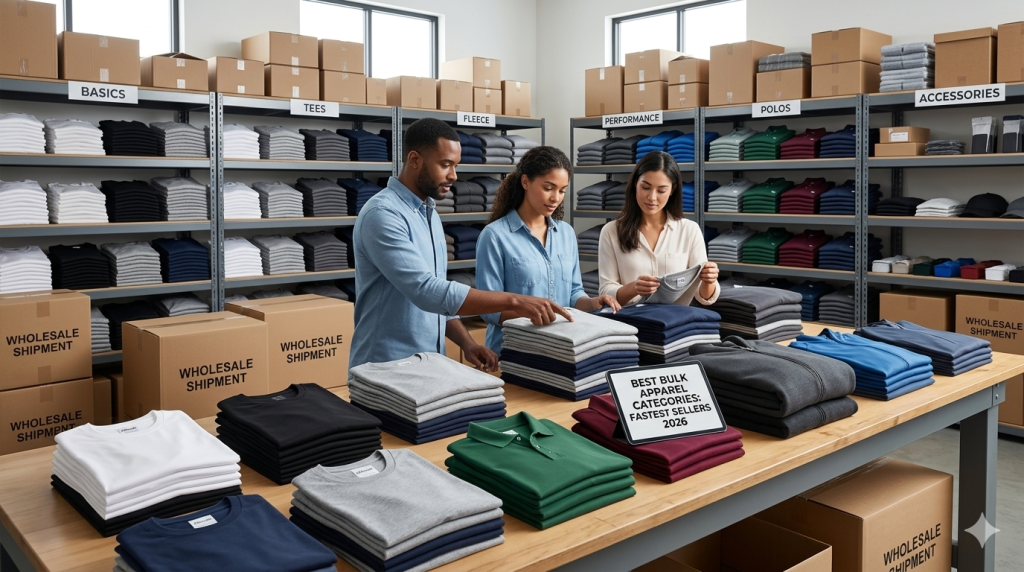
Wholesale apparel buying in 2026 requires sharper inventory decisions than before. Buyers are no longer winning by stocking random volume and hoping it moves. The categories that sell fastest now are the ones that combine repeat demand, broad usability, and easy resale. For wholesale businesses, that means choosing apparel lines that work across retail, printing, uniforms, promotions, and seasonal buying.
The strongest bulk categories are usually simple, practical, and commercially flexible. Buyers who understand which products reorder quickly can protect margins and reduce slow-moving inventory. Instead of overloading shelves with too many weak options, smart wholesalers are building tighter assortments around proven sellers. That is exactly what makes category planning so important in 2026.
Categories That Continue to Sell at Scale
Basic tees still lead the market because they are easy to stock, easy to decorate, and easy to resell. Wholesale T-Shirts remain one of the safest categories for bulk buyers because demand comes from schools, brands, events, print shops, and general retail. They also create fewer fit and styling issues than trend-heavy products. That makes them one of the most dependable starting points for wholesale inventory.
A stronger tee assortment usually performs better than a one-style approach. Wholesale Pocket T-Shirts help buyers add variation without increasing inventory risk too much. They work especially well in boutique retail, lifestyle merchandise, and branded casual collections. Small style differences like this can improve sell-through without disrupting the stability of the category.
Product Lines With Reliable Year-Round Demand
Some categories stay valuable because they work across multiple seasons instead of only peaking once or twice a year. Wholesale Long Sleeve T-Shirts continue to perform because they fit transitional weather and serve both casual and organizational buyers. They work well for staff apparel, schoolwear, light layering, and event merchandise. That kind of flexibility gives them strong year-round relevance.
Warm-weather volume still matters just as much in bulk buying. Wholesale Short Sleeve T-Shirts continue to move because they remain one of the easiest products to sell in quantity. They are simple to print, easy to size, and familiar to almost every type of apparel buyer. Categories that require little explanation usually outperform the ones that need heavy selling.
Inventory Types That Perform Across Multiple Markets
Performance categories are no longer niche add-ons. Wholesale Performance T-Shirts now have strong value because they fit activewear, sports events, gyms, staff programs, and outdoor use. They also tend to carry better perceived value than standard basics. That gives wholesale buyers more room to protect pricing while still offering a practical product.
At the same time, fit variation still helps broaden buyer appeal inside a stable category. Wholesale V-Neck T-Shirts remain useful because they give retailers and branded apparel buyers another proven silhouette without forcing a major style gamble. They are still wearable, familiar, and commercially safe. That is exactly the kind of variation that supports stronger category depth.
Categories That Support Better Seasonal Sell-Through
Layering products remain important because they help buyers sell through changing weather without relying only on heavy cold-season stock. Wholesale Jersey T-Shirts perform well here because they feel slightly more elevated than standard tees while staying easy to wear and easy to merchandise. They often work well in casual retail and branded collections where buyers want something slightly cleaner. That gives them value beyond just being another basic tee.
When the weather shifts, fleece becomes one of the most commercially important categories in wholesale. Wholesale Sweatshirts continue to move because they are comfortable, practical, and easy to position across multiple customer types. They sell well in schools, teams, custom printing, retail, and promotional use. Few categories deliver that kind of broad consistency.
Product Lines That Hold Value Across Seasons
Some fleece styles perform well because they stay simple and commercially safe. Wholesale Crew Neck Sweatshirts continue to sell because they are easy to wear, easy to decorate, and useful across both resale and branded programs. They also fit cleanly into schoolwear, staff apparel, and custom merchandise. Products with that kind of simplicity tend to reorder faster.
More casual fleece still holds strong demand because familiarity keeps it commercially reliable. Wholesale Pullover Sweatshirts remain valuable because they appeal across age groups and fit naturally into retail, merch, and everyday casualwear. They are not difficult to style or explain, which makes them easy for buyers to move. That kind of low-friction demand matters a lot in bulk selling.
Fast-Moving Inventory With Broader Buyer Appeal
Some sweatshirt styles stay strong because they fit specific commercial needs while still staying wearable. Wholesale Quarter-Zip Sweatshirts continue to perform well in hospitality, office layering, school staff apparel, and business casual programs. They offer a cleaner presentation than many casual fleece products. That makes them useful for buyers who need comfort without sacrificing appearance.
Versatility also keeps certain fleece styles moving across broader channels. Wholesale Full-Zip Sweatshirts remain a practical option because they are easy to layer and useful in changing temperatures. Buyers often prefer them when they want a functional product that works in both indoor and outdoor settings. Products with more day-to-day flexibility usually have stronger reorder potential.
Categories That Capture Trend-Led Demand Without Excess Risk
Trend-sensitive products can still be worth stocking when they are tied to already proven categories. Wholesale Cropped Sweatshirts continue to sell because they give younger-focused retail and branded collections a more fashion-aware option. They work best when used in controlled quantities rather than treated like a core staple. That is how buyers benefit from trends without letting trends control the inventory.
Comfort-driven styling is still influencing bulk buying decisions in 2026. Wholesale Oversized Sweatshirts remain relevant because they fit current casualwear preferences while still being easy to sell in merch, resale, and youth-oriented programs. Buyers can use them to reach more style-conscious demand without stepping into high-risk novelty stock. That makes them commercially useful, not just fashionable.
Product Categories That Strengthen Commercial Assortments
Wholesale buyers usually perform better when they build around complete category coverage instead of tops alone. Wholesale Outerwear helps strengthen assortments because it adds higher-value pieces that support seasonal buying and practical use. Jackets and light layers often work well in schoolwear, events, branded programs, and staff apparel. That makes outerwear a strategic category, not just a seasonal add-on.
Supporting items can also improve order size when they are selected with purpose. Wholesale Accessories continue to help because they are easier to cross-sell and easier to test in smaller quantities. They add flexibility to a catalog without creating major size management issues. Categories that are simple to add and simple to move usually make wholesale programs stronger.
Categories That Expand Buyer Reach and Margin
Wholesale businesses often increase average order value by adding commercially useful supporting categories. Wholesale Bags remain a smart category because they fit school, event, retail, and promotional demand with very little resistance. They also work well in branded programs where buyers want products beyond standard apparel. That kind of flexibility makes it easier to scale.
Business casual still matters because many buyers want products that sit between casual basics and formal wear. Wholesale Polos continue to perform because they work in uniforms, events, officewear, and resale environments. They are familiar, practical, and easy to position across different industries. That makes them one of the more dependable mid-range apparel categories.
Inventory Lines That Stay Useful Across Work and Casual Channels
Products that work in both uniform and resale settings tend to offer stronger long-term value. Wholesale Long Sleeve Polo Shirts remain commercially useful because they support cooler-weather uniforms and more polished casualwear. They also help buyers add seasonal variety without stepping outside a proven category. That kind of controlled expansion is much smarter than adding random new product lines.
Function-focused workwear continues to gain relevance in many B2B buying channels. Wholesale Performance Polo Shirts sell well because they combine a cleaner appearance with comfort-driven wearability. They work especially well for active workplaces, event staff, and business programs that need breathable apparel. Products that solve practical problems usually keep moving.
Product Groups That Reward Smart Category Depth
Some categories improve when buyers introduce small functional differences rather than full category changes. Wholesale Pocket Polo Shirts remain useful because they appeal to workwear, service environments, and more traditional uniform buyers. A small feature like a pocket can increase product usefulness without making inventory harder to manage. Those subtle details often matter more in B2B than in trend-led retail.
Broad-use categories still perform best when they stay simple and wearable. Wholesale Short Sleeve Polo Shirts continue to move because they fit hospitality, schoolwear, events, and everyday business casual use. They are easy to stock and easy to reorder because demand patterns are already familiar. That makes them a very safe category in wholesale apparel planning.
Categories That Benefit From Familiar Fabric and Fit
Fabric confidence still influences how easily a product sells, especially in categories tied to comfort and repeated wear. Wholesale Cotton Polo Shirts continue to hold value because buyers trust the familiarity and wearability of cotton-based products. They are easy to position in uniforms, retail, and daily-use programs. Familiar fabric often helps reduce hesitation during the buying decision.
More structured categories still deserve space when buyers serve business or presentation-focused customers. Wholesale Dress Shirts remain relevant because they fit hospitality, officewear, event staffing, and corporate apparel needs. They may not move like tees or fleece, but they still support important B2B demand. The mistake is not stocking them strategically, it is overstocking them.
Smaller Categories That Keep Inventory Moving
Smaller add-on categories continue to help wholesale buyers maintain flexibility without creating heavy inventory pressure. Wholesale Headwear remains a strong category because it supports retail, sportswear, promotional buying, and branded merchandise all at once. It also avoids the sizing complexity that comes with core garments. That makes it one of the easiest categories to scale cleanly.
Cold-season accessories still matter because they help buyers extend demand without taking on oversized inventory risk. Wholesale Beanies continue to move because they are affordable, wearable, and easy to bundle with fleece or outerwear. They also work well in schoolwear, winter merch, and lifestyle retail. Simple seasonal products often create surprisingly strong reorders.
Product Types That Stay Strong in Casual and Promotional Selling
Cap-based products remain useful because they balance fashion appeal with broad practicality. Wholesale Trucker Hats continue to sell because they fit outdoor events, branded collections, merch lines, and casual retail without much effort. Their visual appeal also helps them perform well in online and in-person selling. Easy-to-display categories usually have an advantage.
Broader-use hat styles still hold strong commercial value in bulk. Wholesale Caps remain dependable because they work across school events, staff programs, giveaways, and everyday retail. Buyers also like them because they are easy to decorate and easy to reorder. That combination keeps them relevant year after year.
Product Segments That Continue to Benefit From Brandability
Some headwear categories keep selling because they hold stronger identity in fashion and merch-driven spaces. Wholesale Snapback Hats continue to move because they remain popular in youth-oriented retail and branded apparel programs. They give buyers a more defined style option without becoming overly niche. That balance keeps them commercially useful.
Function-based headwear also deserves more attention from wholesale buyers. Wholesale Performance Hats continue to perform because they fit outdoor use, activewear, event branding, and practical teamwear. Buyers who add them can diversify their headwear assortment without drifting into weak novelty products. That kind of practical variety helps strengthen the category.
Brand-Led Inventory Still Holds Strong Value
Brand recognition still matters because buyers usually move faster when they trust what they are ordering. Wholesale Pants often sell better when they come from labels with stronger fit consistency and product familiarity. Bottoms are harder to buy confidently than tees or hats, so brand reliability matters more here. That makes pants a category where sourcing discipline is critical.
Entry-level trusted labels still play an important role in volume-based wholesale buying. Wholesale Port and Company remains valuable because it gives buyers practical, affordable basics with broad commercial use. It works especially well in organizations, custom printing, and large program buying. That kind of consistency is hard to replace.
Familiar Brands Continue to Support Buyer Confidence
Buyers often place bigger or faster orders when the brand already carries trust in the market. Wholesale Port Authority Clothing continues to perform because it supports business casual, uniforms, and cleaner presentation-driven apparel categories. It is especially useful for buyers serving professional or organization-based demand. Trusted labels reduce hesitation, and hesitation slows sales.
Sustainability-related demand still has a place, but only when it remains commercially realistic. Wholesale Allmade Apparel works well for buyers who want a more conscious product option without sacrificing practicality. It is most effective when positioned as a thoughtful category extension rather than a full assortment shift. Smart buyers add value without overcorrecting their entire catalog.
Recognizable Labels Still Help Reduce Inventory Risk
Strong, familiar labels still help wholesale businesses avoid unnecessary uncertainty. wholesale Jerzees Apparel continues to hold value because it has long-standing recognition in basics, fleece, and printable products. Buyers already understand where it fits and what kind of demand it serves. Familiarity like that improves buying confidence and reorder speed.
More retail-conscious brands also continue to matter in resale and branded apparel programs. Wholesale Next Level Apparel remains useful because it often fits buyers who want a slightly more elevated basic without losing broad wearability. It tends to perform well in boutique printing, merch, and modern casual inventory. That gives it a practical role inside mixed-category assortments.
Inventory Choices That Benefit From Known Product Reputation
Some labels continue to perform because they fit both quality expectations and current casualwear demand. Wholesale Bella + Canvas Apparel remains relevant because it supports modern basics that still feel commercially accessible. Buyers often use it when they want a more polished casual product without drifting into harder-to-move fashion inventory. That makes it strategically useful in 2026.
Youth-related categories should not be ignored just because adult basics dominate most buying conversations. Wholesale Rabbit Skins Clothing continues to hold value because youth apparel still supports schools, family events, branded programs, and custom orders. Buyers who overlook youth lines often miss easy repeat-demand opportunities. That is a blind spot, not a strategy.
Brand Diversity Helps Strengthen Category Coverage
A better wholesale assortment usually includes more than just one or two major labels. Wholesale Anvil Clothing still has value because familiar supporting brands help buyers widen their assortment without creating too much sourcing complexity. Recognizable basics are easier to sell than unknown alternatives with no buying history behind them. That kind of familiarity still matters wholesale.
Controlled brand expansion also helps strengthen category coverage when it fills real product gaps. Wholesale Volunteer Knitwear Apparel works best when buyers want another recognizable option inside practical basics and casualwear. Supporting brands should improve assortment quality, not clutter it. Buyers who understand usually build cleaner and more profitable catalogs.
Conclusion
The best bulk apparel categories in 2026 are the ones that meet real demand and sell consistently without creating unnecessary inventory risk. Tees, fleece, polos, outerwear, headwear, and trusted brand-led products continue to perform because they are practical, versatile, and easy to reorder.
The strongest wholesale buyers will not be the ones with the biggest catalog, but the ones with the smartest inventory mix. In 2026, focusing on proven categories, controlled expansion, and reliable products will lead to better turnover and stronger margins.
FAQ
1) What bulk apparel category sells the fastest in 2026?
Basic T-shirts still lead because they are easy to decorate, easy to reorder, and useful across many buyer types. They remain one of the lowest-risk categories in wholesale.
2) Are sweatshirts still worth buying in bulk this year?
Yes, because fleece remains one of the strongest layering categories for both resale and custom use. It also supports stronger order values than many lightweight basics.
3) What is the safest category for new wholesale buyers?
Core basics like tees, polos, and sweatshirts are usually the safest starting point. They have broader demand and more predictable reorder patterns.
4) Which categories work best for custom printing businesses?
T-shirts, crewnecks, hoodies, and caps are usually the strongest because they are easy to decorate and easy to resell. Demand is already established in those categories.
5) Are trend-based products worth adding in 2026?
Yes, but only in controlled amounts. Trend-led items should support proven categories, not replace them.
6) What apparel categories work best for schools and events?
Tees, sweatshirts, polos, bags, and caps usually perform best because they are practical and easy to brand. They also support repeat seasonal demand.
7) How can wholesale buyers avoid overstocking?
Focus on categories with repeat demand and proven reorder behavior. It is usually smarter to go deeper in strong categories than wider in weak ones.
8) Do polos still sell well in 2026?
Yes, especially in uniforms, hospitality, schoolwear, and business casual channels. They remain one of the more stable mid-range categories.
9) Are branded wholesale apparel lines still important?
Absolutely, because trusted brands improve buyer confidence and reduce fit or quality uncertainty. That usually helps products move faster.
10) What category helps increase average order value?
Outerwear, fleece, polos, bags, and headwear usually help increase order size. These categories make it easier to build fuller apparel programs.