
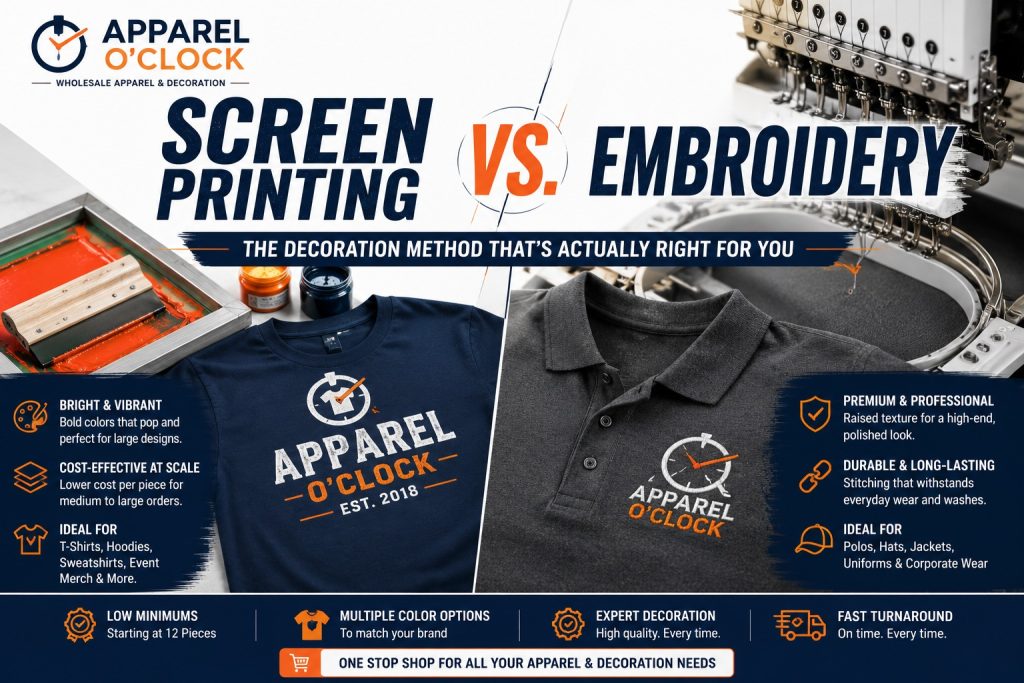
Every bulk apparel order comes down to the same question at some point: screen printing vs. embroidery — which one is right? The answer isn’t obvious. Screen printing wins on some jobs, embroidery wins on others, and picking wrong can cost you real money or leave you with a finished order that doesn’t match the look you wanted.
This guide breaks down the actual decision. Not just what each method is, but when to pick each one, why, at what quantity, and on what fabric. By the end, you’ll know exactly which method fits your project — and whether a third option (like DTF printing) might be a better fit entirely.
At Apparel O’ Clock, we handle every decoration method in-house — screen printing services, embroidery services, and DTF printing services — so this guide reflects what we’ve learned from tens of thousands of actual bulk orders, not what a spec sheet says on paper.
What Screen Printing Actually Is
Screen printing pushes ink through a mesh stencil (the “screen”) onto the fabric, one color at a time. Each color in your design needs its own screen. The ink sits on top of the fabric, cures under heat, and becomes a durable, bright, flat print.
Screen printing has been the dominant decoration method for custom t-shirts and bulk apparel for decades because the math is unbeatable at scale: high setup cost per screen, but the per-piece printing cost is tiny once the screens are made. Print 500 shirts and the setup fee gets spread across every shirt in the run.
What it looks like: Bright, flat, vibrant colors sitting on top of the fabric. Bold, graphic, punchy.
What it feels like: Slight raised ink texture that softens after the first wash. On larger prints, you can feel where the ink sits.
What Embroidery Actually Is
Embroidery stitches your design directly into the fabric using a computerized embroidery machine. The design gets “digitized” (converted into stitch instructions), then the machine embroiders it onto the garment using thread — usually rayon or polyester.
Embroidery has been the dominant decoration method for corporate uniforms, polo shirts, and premium apparel for the same reason screen printing dominates tees: it deliversf exactly what corporate buyers need — a raised, textured, executive-grade finish that reads as premium at first glance.
What it looks like: A raised, dimensional logo with visible thread texture. Premium, professional, tactile.
What it feels like: Sturdy and slightly stiff over the embroidered area. The stitching adds real weight and structure to the fabric under it.
Screen Printing vs. Embroidery: The Head-to-Head
Here’s where the two methods sit on the factors that actually matter for a bulk order.
|
Factor |
Screen Printing |
Embroidery |
| Best per-piece cost | Lowest at 50+ pieces | Similar across quantities |
| Setup fees | High per color | Digitization fee (one-time) |
| Best design type | Bold, simple, 1–4 colors | Logos, monograms, small details |
| Best fabric | Cotton, cotton-poly blends | Structured knits, fleece, twill |
| Look and feel | Flat, bright, vibrant | Raised, textured, premium |
| Best size range | Large (up to full front/back) | Small to medium (up to 4″–5″ wide) |
| Durability | 50+ washes with color retention | Lifetime of the garment |
| Minimum order | Typically 12–24 pieces | Typically 12–24 pieces |
| Best fit for | Tees, sweatshirts, event merch | Polos, hats, jackets, uniforms |
This table is the shortcut, but the real decision depends on your specific project. Let’s walk through when each one wins.
When Screen Printing Is the Right Call
Screen printing wins in five specific situations. If your project fits any of them, screen printing is almost certainly the right pick.
- You’re ordering 50+ pieces of the same design. The screen-printing setup cost gets spread across every shirt in the run. At 100 shirts, per-piece printing cost drops dramatically. At 500, it’s the cheapest decoration method available, period.
- Your design has 1–4 colors and clean edges. Screen printing produces its best results on bold, graphic designs — logos, text, illustrations with flat color areas. Photo-realistic art with gradients and thousands of colors is a job for DTF printing, not screen.
- You’re decorating t-shirts, sweatshirts, or event merch. Cotton and cotton-poly blends take screen printing beautifully. The ink adheres cleanly, cures well, and holds color through the entire life of the shirt. Bulk t-shirt printing is the category screen printing was built for.
- You want bright, vibrant color that pops. Screen-printed ink is more opaque and more saturated than most other methods. On dark shirts, printers use an under-base layer to keep colors bright.
- Your design goes on the chest, back, or as a large graphic. Screen printing shines on medium-to-large designs. A 12″ chest print looks crisp and bold. A full-back graphic is a screen-printing signature.
Browse our wholesale t-shirts and hooded sweatshirts categories for the blanks that pair best with screen printing.
When Embroidery Is the Right Call
Embroidery wins in five different situations. If your project fits any of them, embroidery is the right pick.
- You’re decorating polos, hats, jackets, or structured garments. These fabrics were designed for embroidery. The dense knit, twill, or fleece anchors stitching cleanly, and the raised texture reads as premium. Trying to screen print a polo just doesn’t produce the same finish. Browse our polo shirts and headwear categories.
- Your logo is small to medium (chest, sleeve, cuff, cap-front placement). Embroidery excels at logos under 5″ wide. A 3″ chest logo or a hat-front logo is embroidery’s home turf. Try to embroider a full-back graphic and you’ll pay a lot for a heavy, stiff result.
- You’re running a corporate, executive, or uniform program. Embroidery is the industry standard for corporate apparel — hospitality uniforms, executive gifts, real estate, country clubs, financial services, hospitals. The stitched logo signals “professional” the way a printed logo doesn’t.
- Durability matters more than anything else. Embroidered logos outlast the garment they’re on. A printed logo fades and cracks over years of washing. A stitched logo is still there.
- You want the “premium” tactile feel. Recipients notice embroidery. It carries weight, it has texture, it reads as more expensive than it usually is. For corporate gifts and executive programs, this alone is often the deciding factor.
Cost Comparison: What Each Method Actually Costs
Numbers matter more than adjectives. Here’s the real cost picture.
Screen printing typically involves a setup fee per color (often $20–$40 per screen) plus a per-piece printing cost that drops as quantity rises. On a 100-shirt order with a 2-color design, you might see per-piece printing costs in the low single dollars. On a 500-shirt order of the same design, it might drop to under a dollar per shirt.
Embroidery typically involves a one-time digitization fee (often $30–$75 depending on complexity) that converts your logo into stitch instructions. Once digitized, per-piece embroidery cost is based on the stitch count (roughly, how many stitches are in the design). Small chest logos might run $3–$7 per piece. Larger designs cost more.
The key insight: Screen printing wins on cost at higher quantities of the same design. Embroidery holds a steadier per-piece cost across quantities but starts higher.
For a 24-piece polo order with a chest logo: embroidery is almost always cheaper and looks better.
For a 500-piece tee order with a bold graphic: screen printing is almost always cheaper and looks better.
Fabric Compatibility: Which Method Works on What
Getting the decoration-fabric match right prevents most bulk-order regrets.
Screen printing works best on:
- 100% cotton (the gold standard)
- Cotton-poly blends (50/50 is the industry classic)
- Ringspun cotton (softer feel, still holds ink well)
- Heavy fleece cotton blends for hoodies and sweatshirts
Screen printing gets tricky on:
- 100% polyester (dye migration risk — the shirt color bleeds into the print unless you use specialty inks)
- Performance/athletic fabrics (dye migration + stretch issues)
- Waterproof/coated fabrics
Embroidery works best on:
- Pique knit polos (the classic embroidery fabric)
- Heavy fleece hoodies and sweatshirts
- Twill work shirts and jackets
- Structured hats (6-panel, trucker, dad hats)
- Canvas bags and pouches
Embroidery gets tricky on:
- Very thin or stretchy fabrics (the stitching distorts the shirt)
- Mesh (open-knit warps under stitching)
- Waterproof/technical fabrics (needle punctures compromise waterproofing)
For a deeper breakdown of fabric-to-decoration matching, see our guide on how to print t-shirts — most of the same principles apply to any garment.
What About DTF Printing? The Third Option You Should Know
Screen printing vs. embroidery isn’t always the right frame. There’s a third method — DTF (direct-to-film) printing — that’s changed the wholesale decoration industry over the past few years and might beat both for your specific project.
DTF prints your design onto a special film, then heat-presses it onto the shirt. It handles full-color, photo-realistic art beautifully, works on almost any fabric (including polyester and performance), and has no minimums.
DTF beats screen printing when:
- You have a full-color, photo-realistic design
- You’re ordering fewer than 24 pieces
- Your fabric is polyester or a performance blend
- You need mixed designs in a small run
DTF beats embroidery when:
- Your logo is large or has fine detail
- Your budget rules out per-piece embroidery cost
- Your fabric is too thin or stretchy for stitching
DTF loses to screen printing on high-volume orders of the same simple design (screen printing is still cheaper per piece at 200+).
DTF loses to embroidery for that premium tactile look on polos, hats, and corporate uniforms.
If you’re on the fence between screen printing and embroidery, ask whether DTF might actually be the answer instead. Our team handles all three in-house and will steer you to the right one.
How to Decide: A Quick Decision Framework
If you don’t have time for the full breakdown above, use this shortcut.
- You’re printing 50+ tees or hoodies with a bold 1–4 color design → Screen printing
- You’re putting a logo on 24 polos, hats, or corporate uniforms → Embroidery
- You’re doing full-color art or a small order of mixed designs → DTF printing
- You want the premium tactile look → Embroidery
- You want the brightest, most saturated color → Screen printing
- Your fabric is 100% polyester or a performance blend → DTF printing (or specialty screen inks)
- You want the lowest possible per-piece cost at high volume → Screen printing
Still not sure? Send us your design and quantity and we’ll give you a straight recommendation on which method fits — and quote all three so you can compare.
Frequently Asked Questions
What’s the biggest difference between screen printing and embroidery?
Screen printing produces flat, bright, vibrant ink prints that sit on top of the fabric. Embroidery produces raised, textured, stitched logos that sit in the fabric. Screen printing wins on cost at high volume for bold designs; embroidery wins on premium feel for logos on structured garments.
Which is more durable, screen printing or embroidery?
Embroidery. Stitched logos typically outlast the garment they’re on — decades in some cases. Screen prints last 50+ washes with good color retention but eventually fade or crack. For programs where the garment will be worn heavily for years (uniforms, corporate wear), embroidery is more durable.
Is screen printing or embroidery cheaper?
It depends on the quantity and design. For high-volume orders (100+) of a bold, simple design, screen printing is dramatically cheaper per piece. For small orders (24–48) with a logo-sized design, embroidery is often comparable or cheaper. For corporate polos and hats, embroidery is the default because the finish quality justifies the cost.
Can you screen print polo shirts?
Technically yes, but the result isn’t as clean as embroidery — the pique knit fabric doesn’t hold flat prints as well, and the look reads as less premium. Almost every corporate polo order goes out with embroidered logos rather than screen prints.
Can you embroider t-shirts?
Yes, but with caveats. Thin cotton tees can distort under embroidery, and the stitching adds visible weight to the front of the shirt. Small chest logos work fine on heavier tees. For most t-shirt programs, screen printing or DTF produces better results.
What’s the minimum order for screen printing vs. embroidery?
Both typically start at 12–24 pieces to make setup cost-effective. If you need fewer, DTF printing has no minimums and might be the better choice.
Which method works on polyester and performance fabrics?
DTF printing handles polyester and performance fabrics best. Screen printing on polyester requires specialty inks to prevent dye migration. Embroidery works on some performance fabrics but not on stretchy or mesh constructions.
Can I combine screen printing and embroidery on the same shirt?
Yes — combining methods on the same garment is common. A screen-printed graphic on the back with an embroidered logo on the chest is a popular combination for retail merch and premium team programs.
Get Both Methods (and DTF) at Apparel O’ Clock
Whatever decoration method fits your project, Apparel O’ Clock handles it in-house — no third-party middleman, no lost quality control, no missed deadlines. Whether you need bold screen prints on 500 event tees, executive embroidery on 100 corporate polos, or full-color DTF prints on a small mixed-design run, we quote every method side-by-side so you can make the right decision for your budget and audience.
Visit our website Apparel O’clock to start browsing, or jump straight to our most-shopped categories — wholesale t-shirts for print-heavy programs and polo shirts for embroidery-driven corporate work — to see the blanks that pair best with each method.